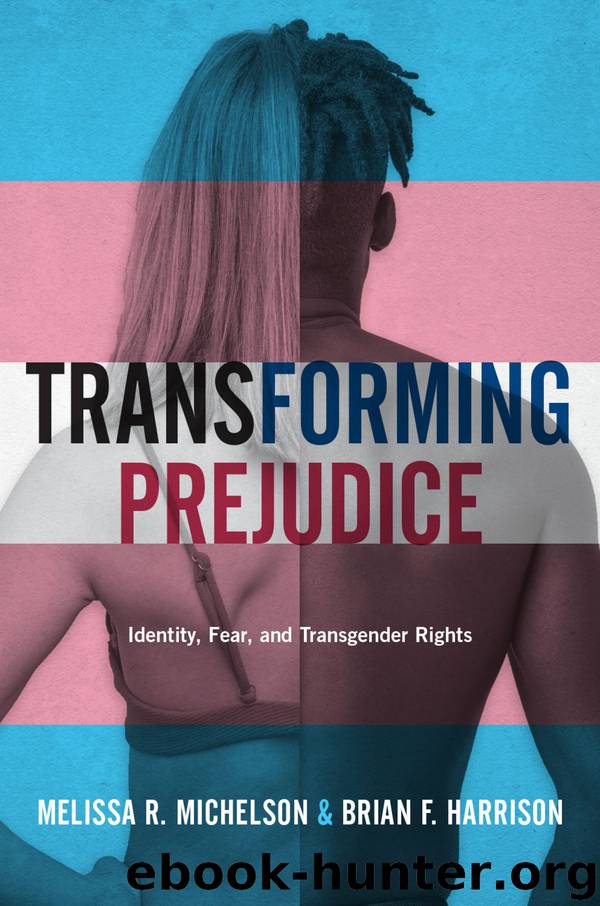
Transforming Prejudice by Melissa R. Michelson
Author:Melissa R. Michelson
Language: eng
Format: epub
Publisher: Oxford University Press
Published: 2020-06-24T16:00:00+00:00
Fear
Fear is a related emotion also used to generate negative attitudes and reduce support for members of marginalized groups. Brader (2005) finds that messages featuring content and imagery associated with threat decrease the salience of prior beliefs and encourage recipients of the fear appeals to reconsider their attitudes. Scholars find that prejudice against gay men and lesbians is based more on disgust than on fear but those studying attitudes toward transgender people find that transphobia (fear of transgender people) does indeed play a role. For example, Nagoshi et al. (2008) find that transphobia is based on fear of expressed deviations from conventional gender identities, which may be interpreted as a threat to their own social identities and status (see chapter 4). Worthen (2013) posits that cisgender men are threatened by transgender women (and gender nonconforming men) because they are relinquishing their male privilege. More specifically, transgender women are a threat for some cisgender men; they tend to view them as men who have been feminized which means “then all men can be feminized which would ultimately result in the breakdown of the conventional social norms in which men are dominant and women are subordinate” (Glotfelder 2012: 71).
Sara Ahmed (2004) writes extensively about the role of fear in cultural politics. Fear allows for the conservation of power and for existing social norms to be preserved. When previously invisible others gain visibility, those attached to the social norms of the present tend to fear change and the loss of control which leads them to establish the other as dangers to their very life and existence. Payne and Smith (2014) extend this understanding of the fear of the other to the introduction of transgender children to elementary schools which leads to what they label “the big freak out.” These children represent a threat to societal notions of gender norms and the binary gender system; thus, the presence of transgender children in schools causes fear and anxiety.
Fear not only decreases support for transgender people and their rights but is even used as a defense in criminal court, as when a man who has violently attacked or murdered a transgender woman claims a trans panic defense for his actions. The trans panic defense is when a defendant argues that “the post-intimate discovery that his transgender female victim had male genitalia was so upsetting that it provoked him into a heat of passion” (Lee and Kwan 2014: 80). The trans panic defense is based on discomfort with gender identity and/or nonconformity, anger at the victim’s alleged deception, and fear by the male defendant that if others find out he was sexually intimate with a transgender woman they will think he is gay: in other words, that his attraction to someone he later learns has male genitalia is a sign of latent homosexuality. “First and foremost, the defendant’s violence may be motivated by his fear of being seen as gay. . . . The heterosexual man who believes in traditional gender roles may also see the fact
Download
This site does not store any files on its server. We only index and link to content provided by other sites. Please contact the content providers to delete copyright contents if any and email us, we'll remove relevant links or contents immediately.
| Anthropology | Archaeology |
| Philosophy | Politics & Government |
| Social Sciences | Sociology |
| Women's Studies |
Lincoln by David Herbert Donald(2021)
Kissinger by Walter Isaacson(1231)
Team of Rivals: The Political Genius of Abraham Lincoln by Doris Kearns Goodwin(841)
A Man Without a Country by Vonnegut Kurt(774)
This Town by Mark Leibovich(718)
A JOURNEY by Blair Tony(624)
Margaret Thatcher: The Authorized Biography by Charles Moore(612)
Power Game by Hedrick Smith(580)
Stik by StiK(528)
The New Prince by Dick Morris(504)
The Good State by A. C. Grayling(497)
From Book to Screen: Modern Japanese Literature in Films by McDonald Keiko I(494)
Means of Ascent by Robert A. Caro(469)
Somebody's Gotta Do It by Adrienne Martini(448)
Extractives Industry Law in Africa by Damilola S. Olawuyi(414)
Talking Across the Divide by Justin Lee(406)
The Kept by James Scott(401)
Washington Rules: America's Path to Permanent War (American Empire Project) by Andrew Bacevich(384)
Washington Rules by Bacevich Andrew(372)
